Top Tips for Requesting a Raise

You’ve been taking on extra projects, yet your paycheck hasn't budged. Discussing money feels awkward, especially when the impact of inflation on current salary squeezes your budget. However, human resources professionals agree this conversation is a standard business transaction, not a personal plea.
Think of pay like a car’s blue book value. Just as a vehicle's price relies on utility rather than sentiment, compensation depends on your "Market Value"—what companies generally pay for your exact skills.
By defining your "Value Proposition"—how you save your manager time or money—you stop feeling greedy and start talking business. Applying proven salary negotiation strategies for employees makes this mental shift easier.
How to Calculate Your Market Value Using the 'Three-Source Rule'
You know your daily responsibilities perfectly, but pricing that work requires looking outside your company walls. This is salary benchmarking: comparing your duties against the broader job market to find your objective worth.
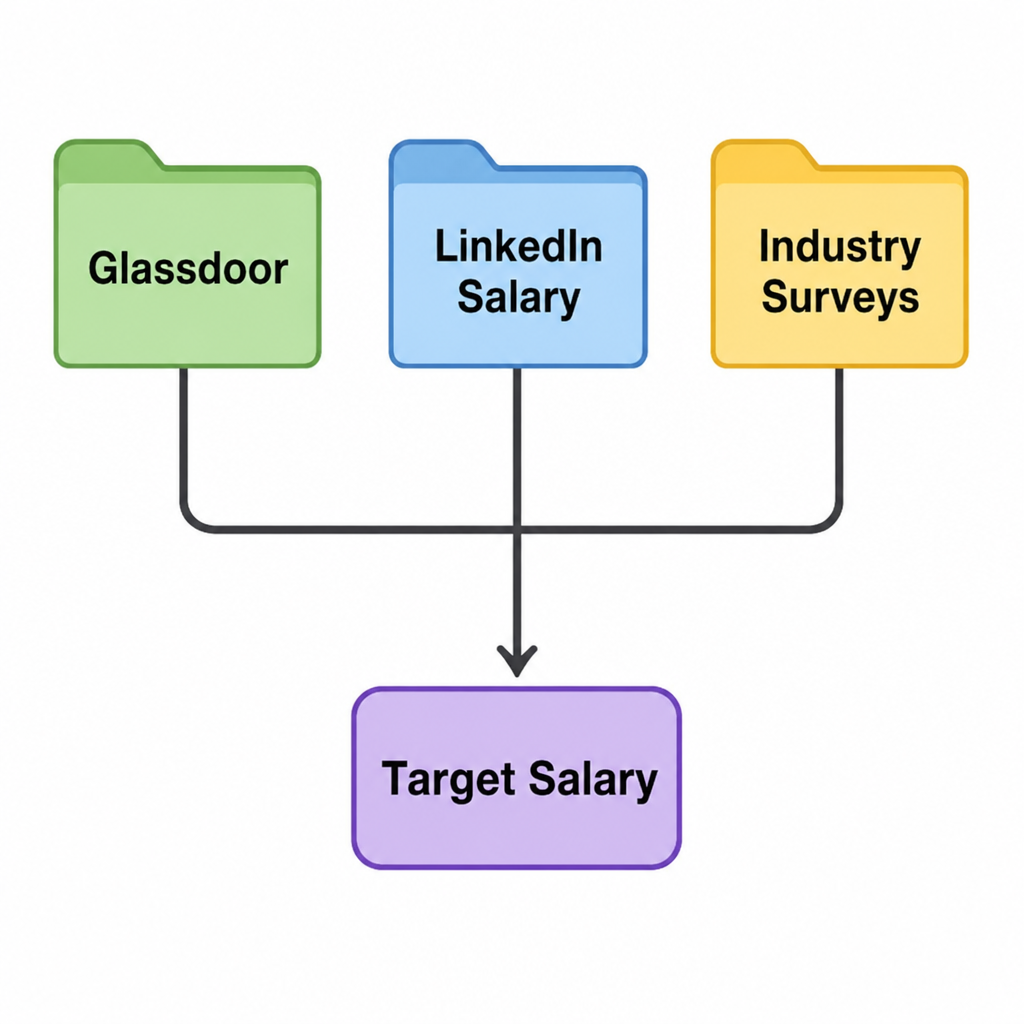
To stop guessing, use the "Three-Source Rule" when researching market value for your job title. Gather baseline data from:
-
Payscale (for customized experience metrics)
-
Glassdoor (for company-specific insights)
-
LinkedIn Salary (for broad professional averages)
-
Local job boards (to define your geographic pay differential, since a retail manager in Seattle naturally costs more than one in Ohio).
Spotting this local data often highlights exactly where you are currently underpaid. Use these figures to build a target compensation range instead of one rigid dollar amount. Presenting a structured range proves to your boss that you researched objective industry standard pay rates by location.
Determining how much of a percentage raise to ask for becomes entirely straightforward once this math is done. With your market rate established, your next task is justifying that number by building a 'Win-List' that proves your impact.
Building a 'Win-List' That Proves Your Impact
Knowing your market rate is only half the battle; now you must prove you belong at the top of that range. Documenting work achievements for salary increase conversations requires highlighting the critical difference between simply fulfilling daily duties and actively exceeding expectations.
Translating daily effort into undeniable proof requires building a business case for a salary hike using "The Power of Percentages." Instead of vaguely stating you worked hard on administrative tasks, frame it as a quantifiable impact: "I reduced scheduling conflicts by 20%, saving the team three hours weekly."
Gather these specific, measured wins into a high-impact employee contributions list. Take a close look at your last twelve months of work and check off:
-
Projects completed ahead of schedule
-
Processes optimized for better efficiency
-
Revenue generated or company money saved
-
Junior staff mentored to success
Condense these verified facts into a clean, one-page summary document to hand to your manager during your meeting. With your objective evidence neatly organized, you are perfectly positioned for timing your request appropriately.
Timing Your Request for Maximum 'Yes' Potential
You already know your performance review schedule, but salary decisions usually happen months prior. Your company's "Fiscal Year"—their 12-month corporate budgeting calendar—dictates the best time of year to request a pay bump. Approach your manager three months before this budget locks.
Navigating this timeline means knowing exactly what you are asking for. Avoid confusing a cost of living adjustment vs merit increase. A cost-of-living adjustment (COLA) simply matches standard inflation to keep your paycheck steady, while a true merit increase specifically rewards the unique achievements on your carefully prepared win-list.
Beyond the corporate budget calendar, leverage momentum. If wondering when to ask for a raise after a performance review, strike immediately following a major project win when your value is freshest in your boss's mind. With your timing strategically aligned, you are ready to prepare your conversation script.
The 'Confident Conversation' Script: Exactly What to Say

Stepping into the room with your market research is only half the battle; knowing exactly how to negotiate salary increase conversations seals the deal. Effective salary raise negotiation tips always center on collaborative language that aligns your hard-earned achievements with the company's broader goals.
To avoid freezing under pressure, use this step-by-step salary increase script for annual review discussions:
-
"Since my last review, I completed [Project A] and streamlined [Process B], saving our team [Time/Money]."
-
"Because my responsibilities have grown, I want to discuss adjusting my compensation to match this added value."
-
"Based on my research, [$X] aligns with the market rate for my current output."
Delivering these lines properly requires physical confidence. Sit straight, keep your hands unclenched, and maintain steady eye contact to prove you fully believe the data you just presented.
After stating your target number, immediately deploy one of the most vital salary negotiation strategies for employees: strategic silence. Practice the "Power of the Pause" by simply waiting for your manager's response, because nervously filling the quiet means you are negotiating against yourself.
Sometimes your boss agrees instantly, but corporate realities might prevent a cash increase today. If you hear a "no," simply pivot toward alternative compensation options.
Beyond the Base Pay: Negotiating Benefits When the Budget is Tight
Hearing "we lack the budget" feels defeating, but handling a raise request rejection professionally proves your maturity. Instead of retreating, view this as the perfect moment to shift the conversation toward other forms of workplace value.
Remember your personal lifestyle priorities regarding time versus money. When cash is tight, companies are highly receptive to negotiating non-salary benefits vs base pay because these perks avoid draining the immediate department budget. This expands your "Total Compensation"—the complete package of your salary and benefits combined.
Pivoting smoothly demonstrates exactly how to bargain for salary increase equivalents. Request these five low-cost, high-value perks:
-
Extra vacation days
-
Flexible remote work
-
Professional certifications
-
Title change
-
A 6-month review clause
That final point establishes "The Bridge to Later." It transforms today's "no" into a guaranteed roadmap for a future "yes" by setting a firm date to revisit the budget. With these alternative options outlined, you are fully prepared to finalize your negotiation strategy.
Your 48-Hour Action Plan to Secure Your Salary Increase
Instead of dreading the conversation, you now have the tools to approach a pay raise negotiation with strategy. Confidence is built through preparation, so finalize your plan:
-
Do research.
-
Write Win-List.
-
Draft script.
-
Send the invite.
Mastering how to negotiate a salary increase requires showing undeniable value. Before setting your Friday deadline to send that meeting request, ask yourself: If you left tomorrow, what would be the hardest task for your boss to replace?
That unique contribution is the foundation of your salary raise negotiation. You have done the hard work of earning it—now step into the room and confidently ask for what you deserve.
Always Keep Your Options Open (And Know When to Walk)
One of the strongest forms of leverage in any salary raise negotiation is having real alternatives. That doesn’t mean threatening to quit—it means quietly building optionality so you can negotiate from confidence, not fear.
If your employer can’t meet a reasonable pay increase (or won’t commit to a clear path and timeline), it’s fair to consider leaving for a role that values your skills at market rate. The goal is simple: never let a stalled negotiation trap you.
To keep opportunities flowing, set up a system that alerts you when companies you want to work for post new roles. Tools like JobNab can notify you when a job goes live on a company’s career page—so you can be among the first to apply before it hits the big job boards.
-
Make a short target list of companies you’d actually join.
-
Use JobNab to get alerts from their career pages.
-
Apply early, then bring that confidence back to the negotiation table.
Best case, your employer matches your value. If not, you’ll already be moving toward your next (better-paid) opportunity.